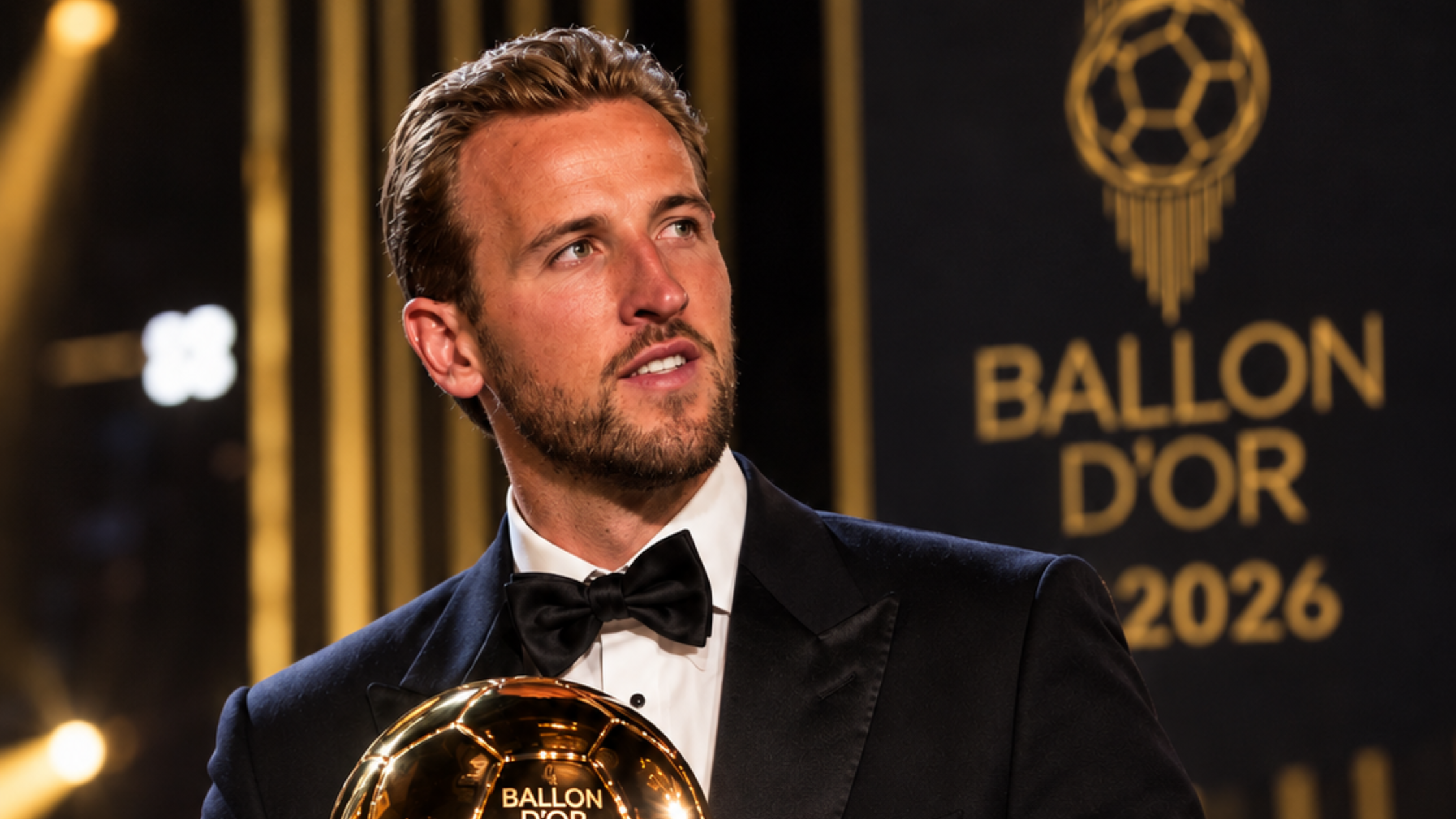
Harry Kane is a deserving winner of the 2026 Ballon d’Or. Yet while his victory is difficult to dispute, the rest of the results have raised serious questions about the judging criteria, the voting process, and the consistency with which players are evaluated.
After spending years among the world’s finest strikers, Harry Kane has finally claimed football’s most prestigious individual honour. The England international won the 2026 Ballon d’Or, finishing ahead of Kylian Mbappé and Lamine Yamal, becoming the first Englishman since Michael Owen in 2001 to receive the award.
And it is difficult to argue that he hasn’t earned it.
Kane enjoyed an extraordinary season, scoring 73 goals in 65 appearances for Bayern Munich and the England national team. He helped the Bavarian giants secure the Bundesliga title, while his performances also proved crucial in European competitions. The England captain also played a key role at the World Cup, where his country finished third.
At a time when individual awards often divide opinion, Kane is a winner whose achievements speak for themselves.
But this is precisely where the debate begins. While his first-place finish seems entirely justified, the rest of the rankings suggest that the same standards may not have been applied equally to every player.
Controversial Rankings and Decisions That Raise Questions
One of the most debatable decisions at this year’s ceremony was the award for the best goalkeeper, which went to Unai Simón. The Spaniard is undoubtedly an excellent goalkeeper who deserves to be considered among the world’s best in his position. However, his victory over David Raya leaves room for debate.
The Arsenal goalkeeper enjoyed an outstanding Premier League campaign, raising the question of how much weight was given to his club performances compared with Simón’s achievements at international level.
Similar questions arise when looking at the overall Ballon d’Or rankings.
Michael Olise, one of the key figures in Bayern Munich’s successful season, finished as low as ninth. His attacking contributions, creativity, and influence on the German champions’ results make a strong case for questioning whether he deserved a higher position.
Erling Haaland, meanwhile, finished eighth despite winning the Premier League Golden Boot and continuing to deliver exceptional goalscoring numbers. At the same time, Mbappé secured second place.
The Frenchman certainly has a strong case for finishing near the top, but the considerable gap between the two strikers once again raises questions about how individual performances are compared and assessed.
Rodri’s fourth-place finish also attracted attention. His quality and influence on the pitch are beyond question, but whether his season was genuinely better than those of several players ranked below him remains open to debate.
Another interesting comparison involves Ferran Torres and Luis Díaz. The Spanish forward finished 16th, while the Colombian was placed all the way down in 24th, despite playing an important role in Bayern Munich’s successful campaign.
Such comparisons do not automatically mean that one player deserved to finish ahead of the other. However, they highlight just how differently comparable individual contributions can be judged.
Questions also surround the list of nominees itself. When certain players who have enjoyed impressive seasons are left out of contention while others make the final 30, it is only natural to wonder where the line is drawn between sporting achievements, reputation, and subjective opinion.
Of course, football cannot be reduced to goals, assists, and trophies alone. But that is exactly why consistency and transparency in the judging criteria are so important. Fans should be able to understand the reasoning behind the final results, even when they disagree with them.
The Problem Isn’t the Winner, It’s the Trust in the Process
The Ballon d’Or has a rich history and remains one of the most significant individual honours in world football. But a reputation built over decades does not mean that the selection process should be beyond scrutiny.
According to France Football’s official regulations, voting is based on three main criteria: individual performances, collective achievements and trophies, and the player’s class and fair play.
The voting panel consists of 100 journalists representing the highest-ranked countries in the FIFA rankings, with each journalist selecting ten players from a pre-established shortlist of 30 nominees.
There is a clear logic behind this system. It ensures international representation and brings together different footballing perspectives.
However, it also leaves considerable room for subjectivity.
Different voters may place vastly different levels of importance on individual statistics, trophies, international performances, or a player’s overall influence on their team’s style of play and results.
That, in itself, is not necessarily a problem. Subjective judgement is an unavoidable part of any individual award in football.
The problem arises when the final rankings appear inconsistent, and there is no sufficiently clear explanation of why one player has finished significantly higher than another.
The process of selecting the initial shortlist also deserves closer examination. When only 30 players are eligible to receive votes, the decision over who makes that list becomes almost as important as the voting itself.
After all, a player who fails to make the shortlist has no chance of winning, regardless of how impressive his season may have been.
Greater transparency, clearer explanations of the judging criteria, and more detailed insight into the voting results could all help restore confidence in the award.
Ultimately, Harry Kane deserves every congratulation that comes his way. His remarkable season and achievements provide more than enough justification for the Ballon d’Or ending up in his hands.
This is not a story about the wrong player winning. It is about an award whose selection process increasingly raises more questions than it answers.
Because the Ballon d’Or’s greatest challenge is not simply choosing the best footballer each year. It is maintaining the public’s trust that every candidate has been judged fairly, consistently, and by the same standards.